
Federal BOP Release Meaning
The Federal Bureau of Prisons confines people serving federal sentences. Its public locator covers many federal records from 1982 forward and updates daily. A former prisoner’s result commonly includes a release date and “RELEASED” or not-in-BOP-custody wording. That confirms the end of the reported BOP custody period, not a complete history of every legal authority.
Federal supervised release can continue through the federal court and probation system. ICE may assume civil immigration custody. A state can hold the person on a separate case. Releases before 1982 may require National Archives research. Keep the conclusion narrow: the record establishes what happened in BOP, on the stated date, for the matched register number.
| BOP field | How to use it |
|---|---|
| Register number | Primary federal identity check |
| Name | Compare exact and variant spelling |
| Age, race, sex | Secondary identity filters |
| Location | Facility or released wording as displayed |
| Release date | Reported BOP custody endpoint, not universal discharge |
Search a Federal BOP Release
Use the official BOP Inmate Locator. Search by register number when known because it is more precise than a name. The number route can accept identifiers used by BOP, the District of Columbia Department of Corrections, the FBI, or the former Immigration and Naturalization Service as the live form allows. A name search can be narrowed with age, race, and sex.
- Choose identifier search when a reliable register number is available.
- Otherwise enter the full legal name and useful biographical filters.
- Open the matching result and compare every identity field.
- Record the release date and location or status wording exactly.
- Check the federal judgment and docket for sentence and supervision details.
BOP Locator Source Record
The official locator capture below is a successful manifest match for federal release research. It shows the correct national system to use rather than a Wayne County jail roster. Review the BOP locator source before entering a name or number.
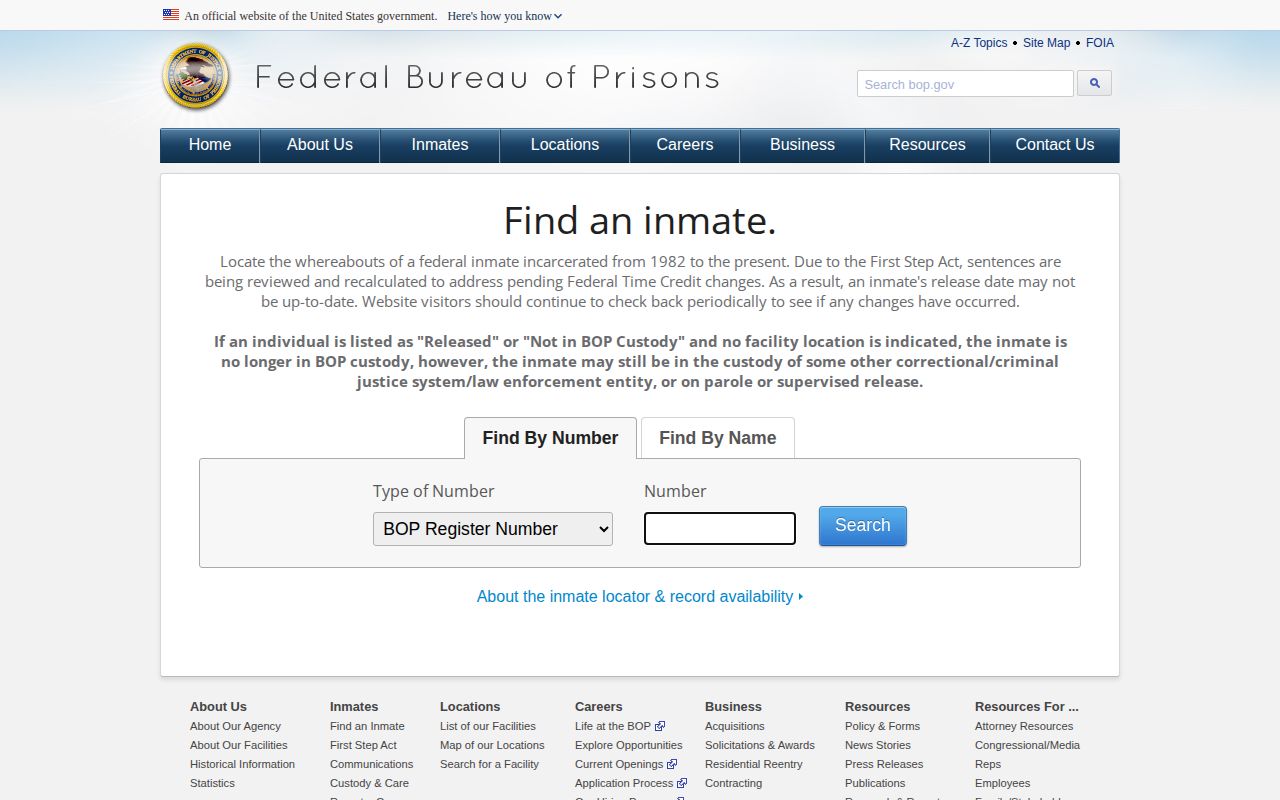
The locator is nationwide. A Wayne County residence, arrest, or family link does not limit the search to West Virginia institutions.
BOP notes that its records can reflect sentencing-law changes and may not capture every pre-1982 release. The locator is a starting point. A federal judgment and BOP records request provide more context for the legal sentence and custody movement.
BOP Versus USMS Custody
The U.S. Marshals Service generally controls federal pretrial detention and prisoner transport. A person held at WRJCF for USMS can be in federal custody without being a sentenced BOP prisoner. A missing BOP result may therefore mean the person is pretrial, transported, outside BOP scope, or identified differently. It does not prove release.
Search the federal court docket for detention, bond, plea, judgment, and commitment orders. Contact the relevant federal clerk for official copies. If public court and facility information do not resolve a historic movement, submit a focused USMS FOIA request. Privacy, safety, and law-enforcement exemptions may limit the response.
- BOP
- Federal prison system for sentenced federal prisoners.
- USMS
- Federal agency that manages many pretrial detainees and transports.
- Supervised release
- Federal court supervision after prison, distinct from West Virginia parole.
- Detainer
- A request or basis for another authority to take custody.
Wayne Federal Custody Handoffs
WRJCF can hold people connected with federal matters, but the state jail record is not a federal sentence record. A person leaving WRJCF for USMS remains in custody. Someone finishing BOP custody may return to a state hold or move to ICE. Each agency’s record proves only its own segment.
Build a timeline with the RJA movement, USMS or federal court event, BOP admission and release, and any later authority. Compare the name, birth data, register number, state OID, case number, and dates. A gap between systems should be described as unresolved until a source fills it.
The Wayne County released inmate search covers the local and state routes that can sit before or after federal custody. Note: A federal release date should not be relabeled as a Wayne County jail release date.
Federal Release Record Requests
BOP’s FOIA route can be used for agency records that the public locator does not supply. Ask for existing records such as designation, custody movement, release date, and release destination information that is lawfully available. Include the full name, register number, date of birth, date range, and preferred format. Third-party access may require consent or face privacy redaction.
The federal court is the source for the judgment and later supervision orders. A judgment may state imprisonment and supervised-release terms. The docket can show later revocation or modification. BOP does not decide federal supervised-release status, and the West Virginia Parole Board has no role in a federal sentence.
Ask the office to identify any exemption used and release segregable nonexempt material. Keep locator screenshots as leads, not certified records. A certified court copy or official BOP response is stronger when formal proof is required.
Confirm Federal Release Destination
A BOP endpoint needs a destination check. The federal docket may show supervised release. An ICE locator match may show civil immigration custody. A WVDCR DOC or RJA match may show state or regional custody. No match in one system should be converted into a broad statement about freedom.
| Possible next status | Verification source |
|---|---|
| Federal supervised release | Federal judgment, docket, and probation channel |
| State prison or jail custody | WVDCR DOC or RJA |
| ICE detention | Online Detainee Locator and ERO |
| Community with sentence complete | BOP record plus court and other-system checks |
Preserve the locator’s date and wording. Then note what other systems were checked and when. This makes the result repeatable without claiming more than the evidence shows.
Older Federal Release Searches
BOP identifies 1982 as the beginning point for locator coverage. Earlier federal prison records may be held by the National Archives. Search requests should include all known names, birth information, conviction district, institution, register number, and approximate dates.
Older records can use different terminology and incomplete electronic indexes. A carefully matched archival response may be needed when no web result appears. Federal court archives can also hold the judgment. Note: Absence from the current locator is not proof that a federal sentence or release never occurred.